
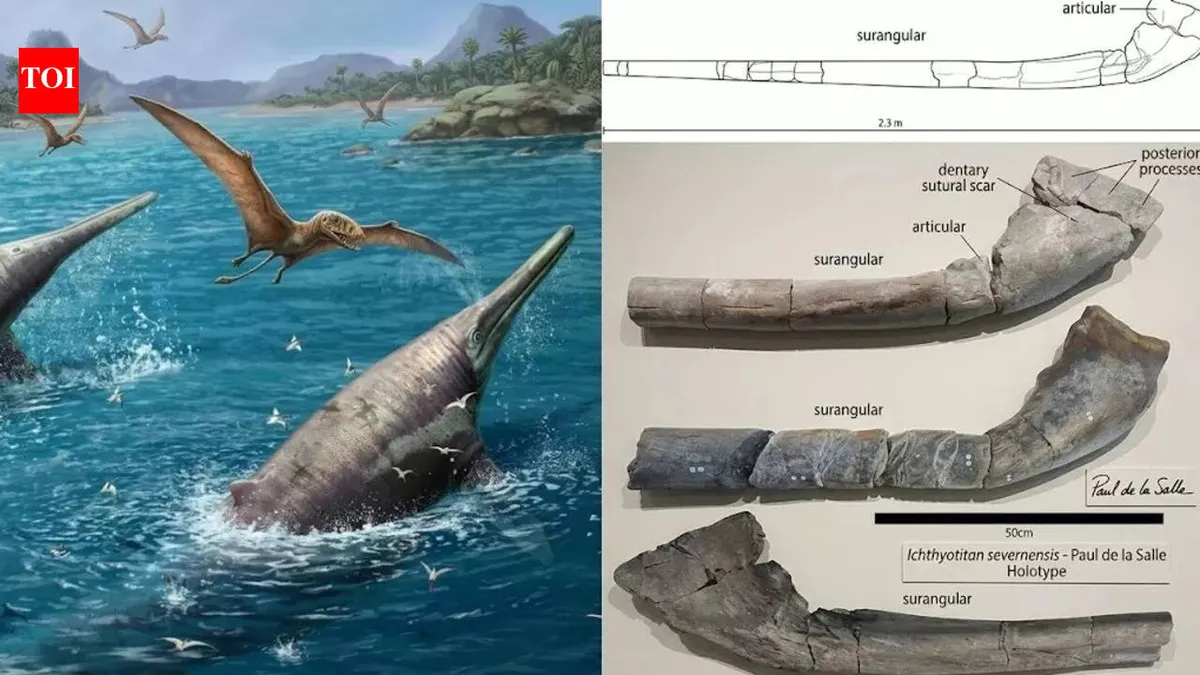
The discovery of Ichthyotitan severnensis raises an intriguing question: how does this newly identified species reshape our understanding of marine reptiles during the Triassic period? The answer lies in its remarkable size and the implications of its existence, which challenge previous beliefs about the timeline of giant ichthyosaurs.
Ichthyotitan severnensis is a newly identified species of marine reptile, discovered by 11-year-old Ruby Reynolds and her father in May 2020 at Blue Anchor, Somerset, England. The jawbone fragment measures over 6.5 feet long and is part of a species estimated to have reached around 82 feet in length, making it the largest marine reptile ever discovered.
This species lived approximately 202 million years ago during the Late Triassic period. The name Ichthyotitan severnensis translates to “giant fish-lizard of the Severn,” reflecting both its size and the location of its discovery. The fossils were found in the Westbury Mudstone Formation, a site that may hold further treasures for paleontologists.
Dean Lomax, a paleontologist involved in the study, noted, “The jawbone proved so significant because it matched a specimen discovered in 2016.” This comparison was crucial in confirming the species and highlights the importance of ongoing research in the field.
The discovery of Ichthyotitan severnensis challenges the notion that giant ichthyosaurs had disappeared earlier in the Triassic period, effectively redrawing the map of the Triassic oceans. The fossils were described as “unusual and extremely large,” indicating that there is still much to learn about these ancient creatures.
Moreover, this finding underscores the potential for further fossil discoveries along the Somerset coastline, as amateur fossil hunters, including children like Ruby, can contribute significantly to scientific breakthroughs. Ruby Reynolds has even become a co-author on the scientific study describing the species, demonstrating the impact of citizen science.
As researchers continue to explore the implications of this discovery, the field of paleontology may uncover more about the life and environment of Ichthyotitan severnensis. Details remain unconfirmed regarding the full extent of its habitat and behaviors, leaving room for future exploration and study.
Related Posts

Chernobyl: The Impact of : A Legacy of Resilience
The Chernobyl disaster continues to influence lives decades later, exemplified by Oksana Masters, who was born with severe birth defects linked to...

NASA Satellite Crashes: Van Allen Probe A Reenters Atmosphere
NASA's Van Allen Probe A has crashed back to Earth after an extended mission, raising concerns about space debris and satellite management.

NASA Satellite Crashing: Van Allen Probe A Reenters Earth
The Van Allen Probe A has crashed back to Earth after nearly 14 years in orbit, monitored by NASA and the U.S....
Read out all
NASA Satellite Crash: Van Allen Probe A Set to Re-Enter Earth’s Atmosphere
The Van Allen Probe A satellite is predicted to re-enter Earth's atmosphere on March 10, 2026, after 14 years of operation. NASA...
Read out all
Project hail mary
Project Hail Mary, directed by Phil Lord and Christopher Miller, is a film adaptation of Andy Weir's novel, featuring Ryan Gosling as...

Nukes: Recent Developments in : Iran’s Isfahan Site Struck
Iran's Isfahan nuclear site has been struck, raising concerns about the implications for nuclear proliferation in the region. The current state of...