
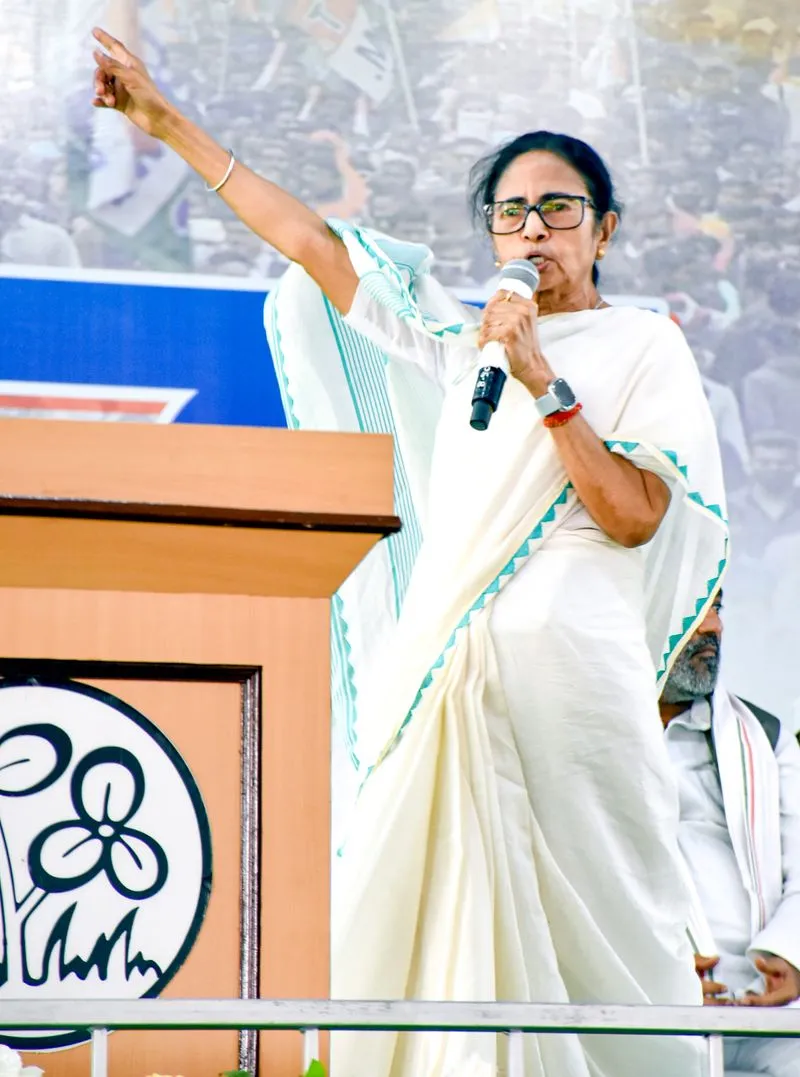
Before the recent developments, the political landscape in West Bengal was relatively stable as the state prepared for the upcoming assembly elections scheduled for April 23 and 29, with counting set for May 4. However, this stability was disrupted when the Election Commission of India ordered the transfer of several senior state bureaucrats and police officials on March 15 and 16.
Mamata Banerjee, the Chief Minister of West Bengal, expressed ‘deep concern and surprise’ over the timing of these transfers, which occurred shortly after the announcement of the assembly elections. The officials affected included key figures such as the Chief Secretary, Home Secretary, and Director General of Police, raising alarms about the implications for the electoral process.
Banerjee described the transfer orders as ‘arbitrary’ and lacking justification, emphasizing that the timing was particularly troubling. She criticized the removal of the Chief Secretary, stating it was executed at midnight without prior consultation with the state government, which she argued undermines the spirit of cooperative federalism.
“It undermines the spirit of cooperative federalism and the established institutional relationship between the state administration and the Election Commission of India,” Banerjee stated, highlighting her concerns over the integrity of the electoral process.
The transfers have intensified political confrontation in West Bengal, with Banerjee asserting, “Don’t treat Bengal as your zamindari. You may change district magistrates, SPs, or inspectors, but you cannot change the people.” This statement reflects her commitment to maintaining local governance and the rights of the state’s citizens.
Furthermore, Banerjee pointed out the gender implications of the transfer, noting, “They chose the hour of midnight to remove a Bengali woman chief secretary without consulting the state government. It shows how anti-women they are.” This comment underscores her view that the actions of the Election Commission are not only politically motivated but also reflect broader societal issues.
As the situation unfolds, the Election Commission’s decisions will likely continue to be scrutinized, particularly given the historical context where such transfers typically involve consultation with the state government. The Commission usually requests a panel of three officers from the state before making a selection for a transfer.
Details remain unconfirmed regarding the long-term implications of these transfers on the electoral process and the relationships between state and federal authorities. However, the immediate effects are clear: heightened tensions and a call for accountability from the state government.
Related Posts

Nsc: Bangladesh Cricket Board Concerns Over Investigation
The Bangladesh Cricket Board has raised alarms regarding a government investigation initiated by the National Sports Council into its recent election.

Israel Iran War News Latest: Escalation Continues
The conflict between Israel and Iran has escalated significantly, with military actions intensifying and a rising death toll in both countries.
Read out all
Arvind Kejriwal Faces Legal Challenges Amid CBI Investigation
Arvind Kejriwal and Manish Sisodia are responding to a CBI petition challenging their discharge in a high-profile liquor policy case.

Dubai Airport Drone Attack Disrupts Flights and Causes Fire
A drone attack near Dubai International Airport has resulted in flight disruptions and a temporary closure of the UAE's airspace. At least...
Israel Iran War UAE: Escalating Conflict and Regional Impacts
The ongoing Israel-Iran conflict has intensified, affecting the UAE with missile threats and civilian casualties. Key figures highlight the severity of the...
Read out all
Rajya Sabha Election Haryana
The recent Rajya Sabha election in Haryana resulted in BJP's Sanjay Bhatia and Congress's Karamvir Singh Boudh winning one seat each, amid...
Read out all