

The numbers
NASA is embarking on an ambitious plan to establish a permanent human base on the Moon, with an investment of $20 billion aimed at supporting continuous activity on the lunar surface. This initiative is part of NASA’s Artemis program, which seeks to return humans to the Moon and create a sustained presence there.
One of the key milestones in this program is the upcoming Artemis II mission, which will carry four astronauts around the Moon, marking the first such mission since 1972. This mission is a significant step forward in human space exploration, as it will pave the way for future lunar landings and the establishment of a base.
In addition to crewed missions, NASA plans to deploy a nuclear reactor on the Moon by 2030, which will provide a reliable power source for future lunar operations. Furthermore, NASA is preparing to test nuclear propulsion in deep space through the Space Reactor-1 Freedom, with tests scheduled before 2028.
International collaboration plays a crucial role in these endeavors. The LUPEX rover, a joint mission involving NASA, the Japan Aerospace Exploration Agency (JAXA), the Indian Space Research Organization (ISRO), and the European Space Agency (ESA), will explore the Moon’s South Pole region. This rover will carry NASA’s Neutron Spectrometer, enhancing our understanding of lunar resources.
NASA’s Deep Space Network will support the operation of the LUPEX rover, ensuring effective communication and data transmission during the mission. The lunar polar environment presents unique challenges, with periods of continuous visibility lasting two weeks, followed by two weeks of non-visibility, which will require careful planning and execution.
NASA Administrator Jared Isaacman stated, “We have moved quickly, taken action to cut bureaucracy, and introduced deregulation focused on empowering the workforce,” emphasizing the agency’s commitment to advancing space exploration efficiently.
Looking ahead, NASA expects to conduct lunar landings at least once every six months, starting with Artemis IV in 2028. This ambitious schedule reflects the agency’s determination to establish a sustained human presence on the Moon and further explore the possibilities of deep space travel.
Details remain unconfirmed regarding the specific outcomes of these missions, but the international collaboration and technological advancements signal a new era in space exploration.
Related Posts
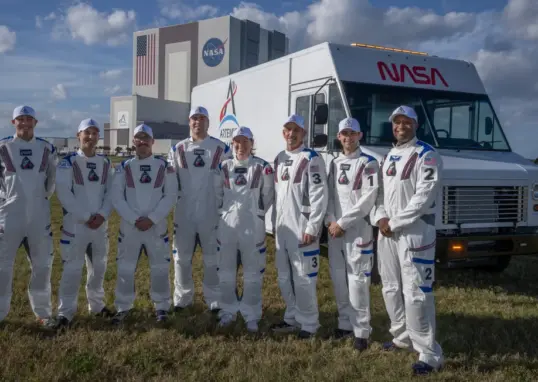
NASA Artemis II Astronauts Set to Make Historic Journey
The NASA Artemis II mission features a crew of four astronauts on a groundbreaking journey beyond Earth's orbit.

Satellite Images Cloud Formation Captures Massive Weather System Over India and Pakistan
Recent satellite images show a massive cloud formation over India and Pakistan, linked to a western disturbance expected to bring severe weather...

Pink moon: The Upcoming : A Celestial Event in April 2026
The Pink Moon will take place on April 1-2, 2026, marking a time of growth and renewal as it becomes visible across...
Read out all
NASA Astronauts Space Station Evacuation
NASA's first medical evacuation from the International Space Station occurred after astronaut Mike Fincke experienced a sudden loss of speech.

Earth Hour Celebrates 20 Years of Global Climate Action
Earth Hour, now in its 20th year, encourages global participation in climate action by turning off lights for one hour. Events are...
Read out all
CSIR Initiatives in Sustainable Infrastructure and Drone Technology
CSIR is leading efforts in sustainable infrastructure through innovative use of waste foundry sand and advanced drone technology.