
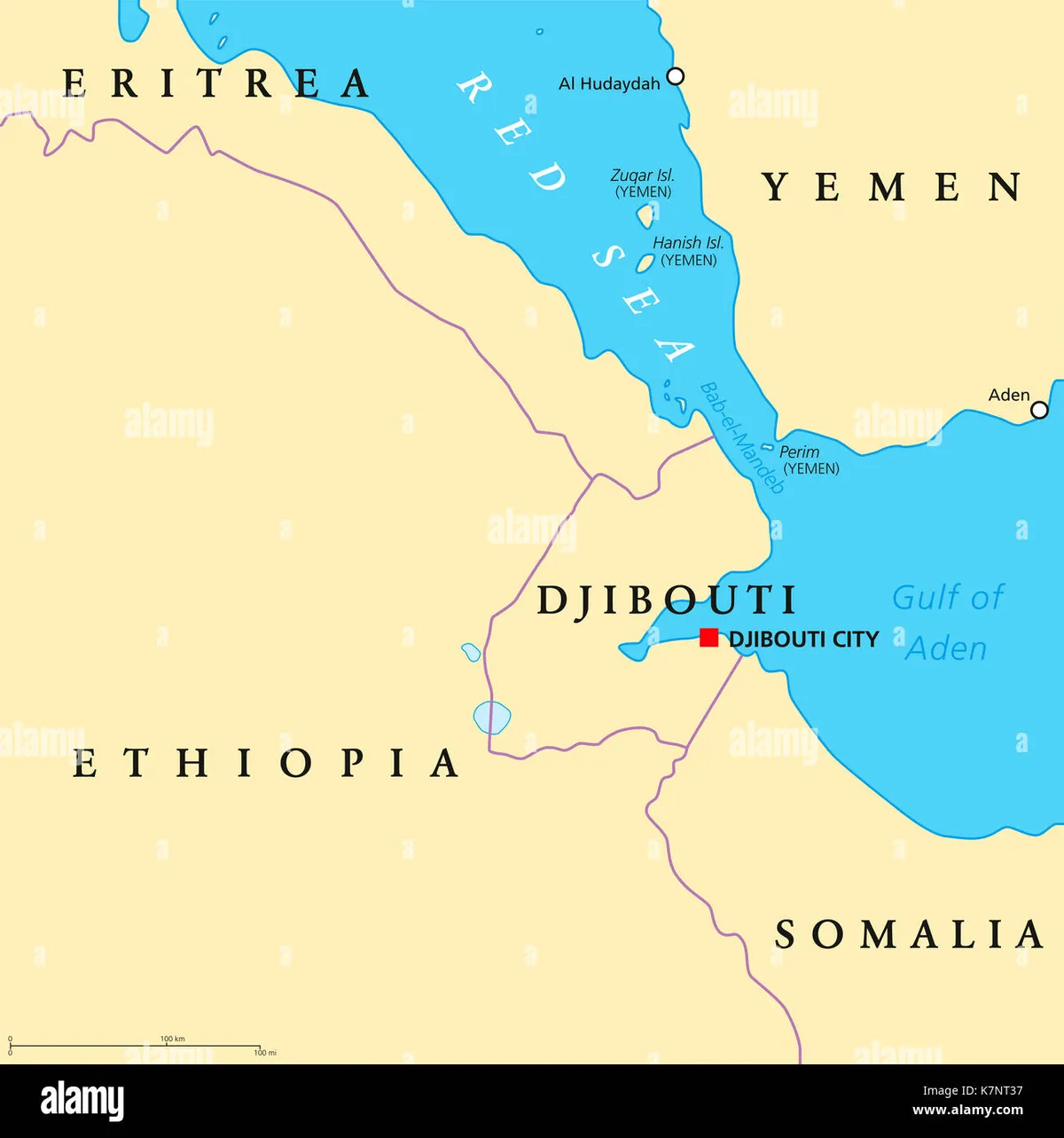
The Bab el Mandeb Strait, a vital maritime passage located between the Horn of Africa and the Arabian Peninsula, raises significant questions about global trade security amid rising geopolitical tensions. Approximately 10% to 12% of the world’s maritime trade transits through this narrow strait, which connects the Red Sea to the Gulf of Aden and serves as the entrance to the Suez Canal.
At its narrowest point, the Bab el Mandeb is just 26 kilometers (16 miles) wide. This strategic waterway sees the transit of about 4 to 9 million barrels of oil daily, with cargo valued at around $1 trillion passing through each year. The strait is often referred to as the ‘Gate of Tears’ in Arabic, highlighting its historical and strategic significance.
Recent developments have seen Iran threaten to block the Bab el Mandeb Strait, a move that could have severe implications for global energy supplies. The Islamic Revolutionary Guard Corps (IRGC) has stated, “The Bab al-Mandab Strait is considered one of the world’s strategic straits, and Iran has both the will and the ability to create a completely credible threat against it.”
In addition, the Houthis, a group based in Yemen, have pledged support to Iran in controlling the strait. This alliance raises concerns about the potential for increased military activity in the region, which could disrupt maritime traffic and escalate tensions further.
The Bab el Mandeb Strait gained prominence after the opening of the Suez Canal in 1869, which significantly increased maritime traffic through the area. Today, it is considered one of the world’s most strategic straits, often compared to the Strait of Hormuz due to its critical role in global energy transport.
As tensions mount, the international community is closely monitoring the situation. The IRGC has warned, “If the enemy wants to take action on land in the Iranian islands or anywhere else in our lands… we will open other fronts for them as a surprise.” This statement underscores the potential for conflict that could disrupt one of the world’s key maritime routes.
Details remain unconfirmed regarding the exact nature of Iran’s plans for the Bab el Mandeb Strait, but the implications for global trade and energy markets are significant. The strait is located 1,200 miles off the Strait of Hormuz, yet its strategic importance is undeniable.
As the situation develops, the focus will remain on how these tensions will impact not only regional stability but also the flow of goods and energy across one of the world’s busiest maritime corridors.
Related Posts

Something Very Bad Is Going To Happen
A new supernatural thriller series set in upstate New York explores a family curse that leads to tragic consequences if not resolved.
Read out all
3 april 2026: Gold Prices and Events on April 3, 2026
Gold prices dropped by 2.8% to approximately $4,650.20 per ounce on April 3, 2026, coinciding with Good Friday in India.
Read out all
CS Reviews State Pragati Portal and Reforms
Chief Secretary Anand Bardhan reviewed the State Pragati Portal, emphasizing the importance of reforms for citizen welfare and business environment.
Read out all
Breaking News: Earthquake Tremors Felt Across North India
A 5.8 magnitude earthquake struck near the Afghanistan–Tajikistan border, with tremors felt across Delhi-NCR and Jammu and Kashmir.
Read out all
3 april: Gold Prices and Horoscope for April 3
On April 3, 2026, gold prices have pulled back after a sharp rally, with significant impacts on domestic rates in India.
Read out all
Tbpn: OpenAI Acquires : A Major Move in Media
OpenAI has acquired the Technology Business Programming Network (TBPN), which is projected to generate over $30 million in revenue this year.
Read out all